How it works
Different races. Fair comparison.
Three surfaces, three verification tiers, three divisions. No black box, no invented maths.
Three surfaces
Where your result shows up.
Event leaderboard
One session at one gym or one official race. Who turned up, who went fastest, on the day.
Race-type leaderboard
Everyone who has run that format, HYROX Men's Solo for example, ranked by time.
ROKD Rank
Your global standing, ordered by ROKD Score rather than a single time.
Score vs Rank
One number. One position.
ROKD Score
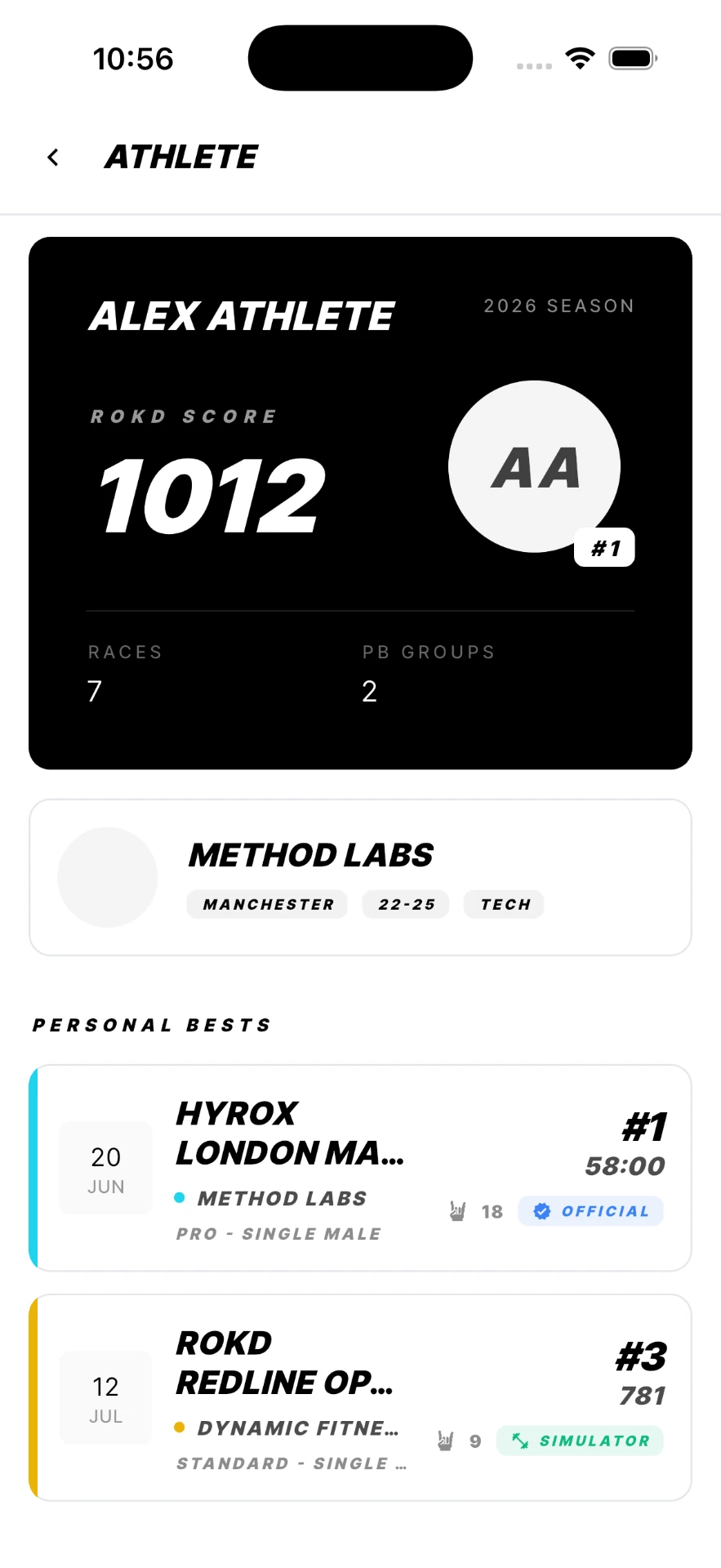
A single number built from your best results this season, for individual efforts only. Official and Simulator results feed it. At-home results do not: they stay in your history instead. Your results are permanent, but your Score reflects the current season.
ROKD Rank
Your position among everyone else, ordered by Score. Apply filters for format, age, city, gym or division and the rank recalculates against that field. Rank is a live season standing, so it always shows where everyone is right now.
Always top X%
We report standing as “top 12%”, never as a percentile number. It is the same maths said the way athletes actually talk.
Verification
Credibility is the whole point.
Every result carries its tier, so nobody has to guess how it was recorded.
Recorded at an official event by the organiser. Feeds your ROKD Score.
Run at a registered gym and uploaded by that gym. Feeds your ROKD Score.
Self-logged. Kept in your history so nothing is lost, but it does not feed your Score.
Divisions
Compared against your own field.
Pro
Full prescribed loads and standards.
Standard
The default division most athletes race.
Scaled
Reduced loads or modified movements, ranked among its own.